
FUNDING & CAPITAL PLANNING RESOURCES
Condition Improvement Funding (CIF): A Complete Guide for Schools
Everything schools, academies and smaller multi-academy trusts need to know about Condition Improvement Funding (CIF), including eligibility, funding priorities, application tips and how to improve the chances of success.
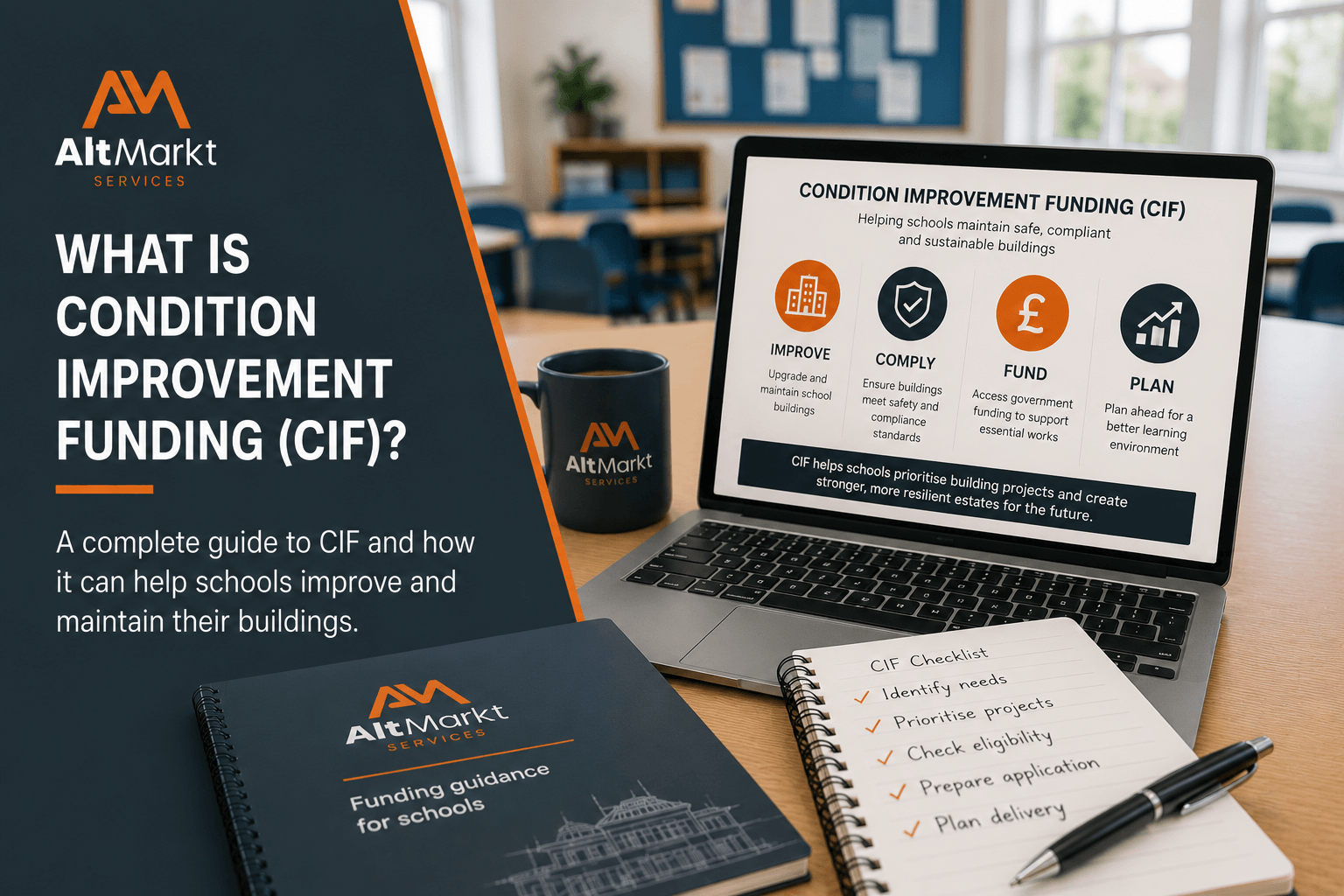
What is Condition Improvement Funding (CIF)?
Condition Improvement Funding (CIF) is a government capital funding programme that helps eligible schools address significant building condition and compliance issues. It is designed to keep education buildings safe, operational and fit for purpose by supporting projects that cannot reasonably be funded through day-to-day maintenance budgets.
For many eligible schools, CIF provides one of the few opportunities to secure substantial capital investment for essential estate improvements. Successful projects often involve fire safety, roofing, mechanical and electrical services, safeguarding, structural repairs and other works that protect the long-term condition of school buildings.
Preparing a strong application requires more than simply identifying a problem. Schools need robust technical evidence, a clear explanation of risk, value for money and a well-planned delivery strategy. This is why many schools choose to work with experienced consultants who understand both school estates and the Department for Education’s assessment process.
At AltMarkt, CIF applications form part of a wider approach to Capital Funding & Investment Planning, ensuring projects are supported by strong technical evidence and aligned with longer-term estate priorities.
Who can apply for Condition Improvement Funding?
CIF is available to eligible academies, sixth-form colleges and voluntary aided schools that meet the Department for Education’s published eligibility requirements for the relevant funding round.
Eligibility criteria are reviewed by the Department for Education each year, so schools should always refer to the latest guidance before preparing an application.
Typically, eligible organisations include:
- Stand-alone academies.
- Smaller multi-academy trusts that fall within the published eligibility thresholds.
- Eligible voluntary aided schools.
- Sixth-form colleges.
- Schools converting to academy status where eligibility criteria are met.
For voluntary aided schools, successful projects usually require the governing body to contribute a proportion of project costs in accordance with current Department for Education guidance.
If you are unsure whether your organisation qualifies, obtaining advice early can save valuable time before investing effort into a full application.
AltMarkt supports both individual schools and Multi-Academy Trusts in understanding eligibility, reviewing estate priorities and identifying whether a proposed project is likely to align with current funding criteria.
Key takeaway
Successful CIF applications are rarely built around a single building defect. They demonstrate how a clearly evidenced condition issue, supported by professional surveys and linked to a wider estate strategy, justifies investment and delivers long-term value.
What types of projects receive CIF funding?
CIF is primarily focused on significant condition need. This means projects that address serious building defects, health and safety risks, statutory requirements or issues that could affect the continued operation of the school are usually strongest.
Typical CIF projects may include:
- Fire safety works.
- Electrical safety and infrastructure upgrades.
- Heating, hot water and mechanical services replacement.
- Roofing works and water ingress prevention.
- Asbestos removal or management-related works.
- Drainage and water services improvements.
- Safeguarding and security improvements.
- Structural repairs or life-expired building fabric replacement.
The strongest applications usually show that the issue is urgent, well evidenced and difficult for the school to manage through routine maintenance alone. Where technical evidence is required, Building Surveying Services can help provide condition information, defect analysis and professional recommendations to support the application.
Which CIF projects are most likely to succeed?
CIF is competitive and demand often exceeds the funding available. For that reason, applications need to align closely with the Department for Education’s priorities and demonstrate why investment is needed now.
Projects that are most likely to be prioritised usually fall into one of three broad areas:
Highest priority: legislation, health and safety, and risk of closure
These are projects where failure to act could create serious health and safety concerns, statutory issues or a risk that the school cannot continue operating safely.
Examples may include fire safety, electrical safety, gas safety, asbestos-related works, drainage failure, safeguarding risks or other defects that could materially affect safe operation.
High priority: life-expired building elements affecting operation
These are projects where significant building elements or services are life-expired and present a clear risk to continued use. This may include major mechanical systems, electrical systems, structural issues, utility connections or other critical infrastructure.
Medium priority: condition issues requiring planned investment
Medium priority projects can still be important, but they may be less likely to succeed if the evidence does not demonstrate immediate risk, operational impact or a clear link to wider estate priorities.
This is why the quality of evidence, condition information and estate planning matters. A project that appears medium priority on the surface may become stronger when the operational risk, deterioration, cost implications and wider estate context are clearly explained.
Why evidence matters
CIF applications are not assessed on need alone. They are assessed on how well that need is evidenced, how clearly risk is explained and how convincingly the project is justified against national priorities.
How can schools strengthen a CIF application?
A strong CIF application should explain the condition issue, show why action is needed, demonstrate value for money and provide confidence that the project can be delivered successfully.
Five areas can make a significant difference:
1. Independent technical evidence
The application should be supported by clear professional evidence. This may include building surveys, structural reports, mechanical and electrical reports, fire risk information, photographs, maintenance records or other specialist assessments.
Evidence should not simply be included; it should be interpreted. The application needs to explain what the evidence shows, why it matters and what could happen if the issue is not addressed.
2. A clear link to estate strategy
A CIF project is stronger when it sits within a clear estate strategy. This helps show that the project is not being treated in isolation, but has been considered alongside other estate needs, priorities and risks.
Our Estate Strategy & Planning Services help schools and trusts understand where projects sit within a wider estate plan and why particular works should be prioritised.
3. Demonstrating value for money
Applications should demonstrate that the proposed solution is proportionate, deliverable and offers long-term value. This often means showing that alternative options have been considered and that the selected approach is the most appropriate route.
A clear options appraisal can help demonstrate that the project has been properly tested before funding is requested. Where schools need support comparing possible routes, Consultancy & Options Appraisal Services can help develop the evidence behind the preferred option.
4. Deliverability and project planning
The Department for Education needs confidence that projects can be delivered successfully. A realistic programme, an achievable procurement route and clear project governance all help demonstrate that the investment can be managed effectively.
Schools should consider how works will be delivered with minimal disruption, whether holiday periods can be utilised and what risks may affect delivery. Early planning often leads to smoother projects and greater confidence during assessment.
Where projects move beyond the funding stage, AltMarkt’s Project Delivery & Management Services help clients oversee procurement, construction and successful completion.
5. Preparing early
One of the biggest mistakes schools make is waiting until the funding round opens before beginning preparation. By then, surveys may not have been completed, options may not have been explored and essential evidence may still need to be commissioned.
The strongest applications are usually those that have been developing over several months, allowing sufficient time to investigate defects, prepare supporting documentation and build a robust business case.
Preparing early gives schools the opportunity to:
- Commission professional surveys where required.
- Develop robust technical evidence.
- Review alternative project options.
- Establish realistic project costs.
- Plan procurement and delivery.
- Strengthen the overall quality of the submission.
How does estate planning improve funding success?
Successful CIF applications rarely exist in isolation. The strongest projects form part of a wider estate strategy that demonstrates how investment supports the long-term future of the school.
Understanding the condition of buildings, identifying future priorities and planning investment over several years enables schools to make better funding decisions. Rather than reacting to individual defects, schools can show how proposed works contribute to a coordinated approach to estate management.
Estate planning also helps schools identify future projects before they become critical, making it easier to commission surveys, prepare evidence and secure approvals well before funding opportunities arise.
If your organisation has not yet developed a longer-term estate strategy, our Estate Strategy & Planning Service provides practical support that links building condition, capital investment and future funding opportunities.
Should schools prepare a CIF application themselves?
Schools can prepare CIF applications themselves, but many choose to seek professional support because of the technical evidence, project planning and funding knowledge required.
Preparing a successful application involves far more than completing an online form. Building condition must be evidenced, risks clearly explained, costs validated and the proposed solution justified against national funding priorities.
Independent professional advice can help strengthen the quality of the submission, identify weaknesses before submission and ensure supporting information aligns with the expectations of the assessment process.
How AltMarkt supports CIF applications
AltMarkt provides independent support throughout the entire funding process, from identifying suitable projects through to preparing applications and delivering successful schemes.
Depending on the needs of each client, support may include:
- Estate reviews and project identification.
- Building condition surveys.
- Options appraisal and feasibility advice.
- Preparation of technical evidence.
- Capital funding strategy.
- Completion of CIF applications.
- Project delivery and contract administration following approval.
Because these services are delivered by one consultancy, schools benefit from continuity throughout the project lifecycle, from the earliest estate discussions through to successful project completion.
Our recent funding success
During the previous Condition Improvement Funding round, AltMarkt secured more than £2.8 million of capital investment for clients, achieving an 80% application success rate.
While every funding round is different and no outcome can ever be guaranteed, this reflects the importance of careful preparation, strong technical evidence and a clear understanding of the assessment process.
Our No Win, No Fee CIF Application Service
Preparing a high-quality Condition Improvement Funding application requires time, technical expertise and detailed planning. We understand that many schools and academy trusts need confidence that professional support represents good value for money.
For that reason, AltMarkt offers a No Win, No Fee service for eligible CIF applications.
This allows schools to access experienced professional support throughout the application process without paying consultancy fees if the application is unsuccessful, subject to our agreed terms and the scope of the commission.
Our objective is simple: to help schools submit the strongest application possible while providing clear, practical advice throughout the process.
Why schools choose AltMarkt
Successful CIF applications are built on more than well-written submissions. They are built on understanding school estates, recognising risk, gathering the right evidence and developing projects that align with both funding priorities and long-term estate objectives.
As an independent estates consultancy, AltMarkt supports schools, academy trusts and public sector organisations across every stage of the estate lifecycle. Our clients often begin with a single survey or funding application before developing a longer-term relationship covering estate strategy, project delivery and capital investment planning.
Our multidisciplinary approach means we can support:
- Estate Strategy & Planning.
- Building Surveying.
- Capital Funding & Investment Planning.
- Consultancy & Options Appraisal.
- Project Delivery & Management.
- Contract Administration.
Rather than treating funding as an isolated exercise, we help clients understand how each investment supports the wider performance, resilience and future development of their estate.
Planning beyond a single funding round
Even where a project is not successful in the current funding round, the work completed is rarely wasted. Surveys, technical evidence, estate planning and options appraisal all contribute towards stronger decision-making and better preparedness for future investment opportunities.
Many of our clients use the CIF process as an opportunity to strengthen their wider estate strategy, creating a clearer understanding of future priorities and developing a long-term programme of improvements that extends well beyond a single application.
That approach reflects how we work as a consultancy: helping organisations make informed estate decisions today while planning confidently for tomorrow.
Need support with your next CIF application?
Whether you are preparing your first Condition Improvement Funding application or developing a longer-term capital investment strategy, AltMarkt can help you build a stronger evidence base, develop robust projects and submit applications with confidence.
Explore our Capital Funding & Investment Planning, Estate Strategy & Planning and Building Surveying Services, or speak to our team about how we can support your organisation.