
ESTATE PLANNING RESOURCES
5-Year Estate Planning for Schools Made Easy
A practical guide to help schools and trusts move away from reactive estate decisions and towards clearer, more confident long-term planning.
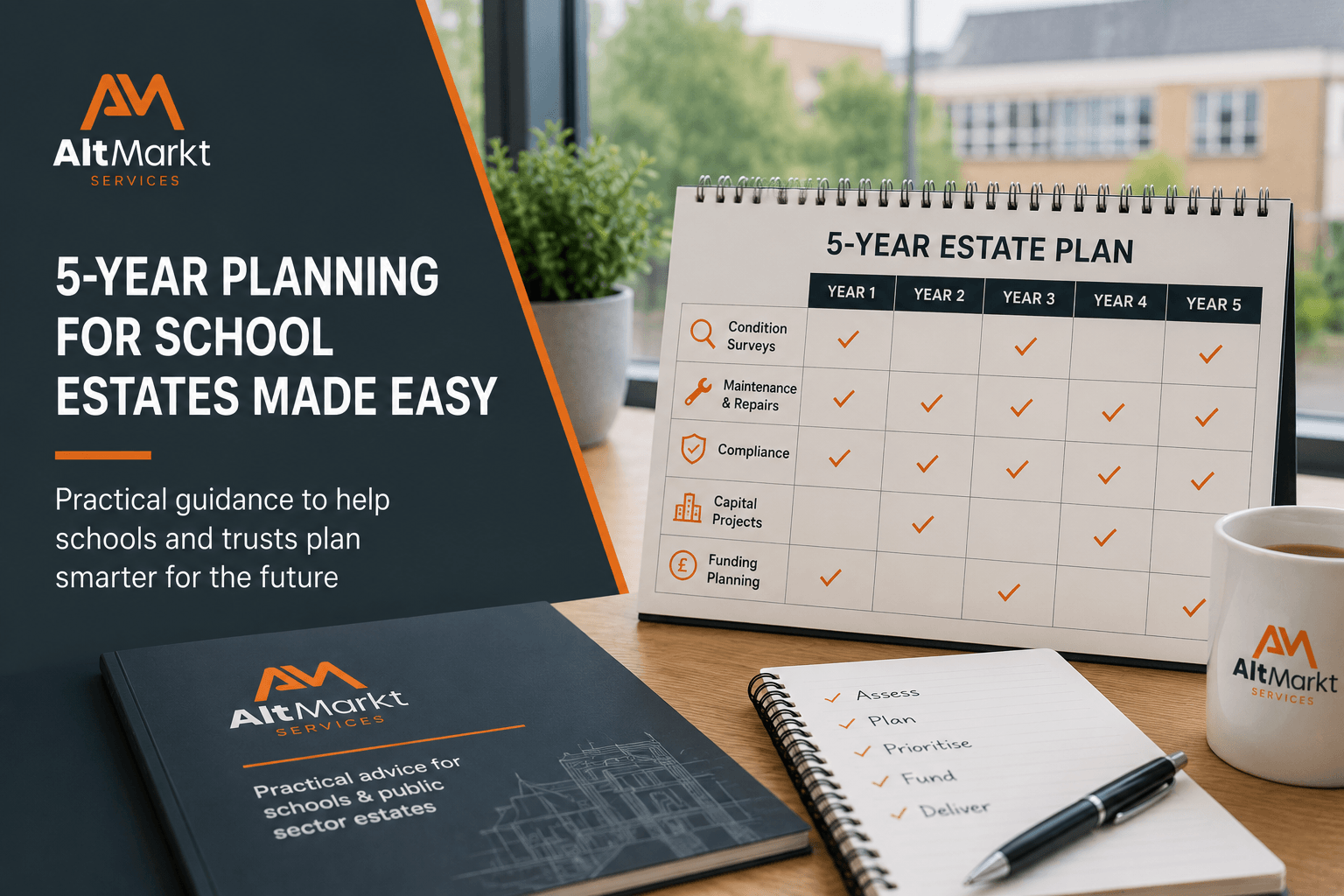
Planning ahead for your school estate
Whether you are planning for the next academic year or looking further ahead, a structured estate plan helps schools move from reactive decisions to long-term investment.
Day-to-day priorities will always come first. Schools need to remain safe, operational and focused on pupils and staff. But without a longer-term view, estate decisions can easily become driven by the most urgent issue rather than the most important priority.
A clear five-year estate plan helps schools and trusts understand what needs attention, what can be phased, what should be monitored and where future investment may be needed.
It is not about creating a complicated document. It is about building a practical roadmap that helps leaders, governors and estates teams make informed decisions about buildings, budgets and future projects.
What do we mean by a five-year estate plan?
A five-year estate plan is a practical roadmap for your school buildings. It brings together information about condition, maintenance, future needs, funding priorities and potential projects in one place.
Rather than responding to issues as they arise, schools can see what is coming, understand what needs attention first and plan works in a way that is manageable, affordable and less disruptive.
For an academy trust, the same principle applies across multiple schools. A trust-wide plan helps compare priorities consistently, allocate investment fairly and explain decisions clearly to trustees and local governing bodies.
What should a five-year school estate plan include?
A good estate plan should be practical enough to use and detailed enough to support decisions. It should not sit on a shelf. It should help the school understand its buildings, plan investment and explain priorities.
A five-year estate plan should usually include:
- Current building condition information.
- Known maintenance priorities and recurring issues.
- Statutory inspection and servicing information.
- Projects that may be needed over the next five years.
- Estimated costs, phasing and likely timescales.
- Funding opportunities and capital investment priorities.
- Risks that need monitoring or further investigation.
- Links between estate needs and the school’s wider objectives.
The most useful plans bring technical information and leadership priorities together. They help schools see the estate as one connected picture rather than a list of separate problems.
Why planning ahead matters
Schools that plan ahead tend to feel more in control of their estates. Early planning allows issues to be identified before they become urgent, costs to be spread more sensibly over time and decisions to be made with better evidence.
It also makes conversations with governors, trustees and senior leaders much easier. A clear plan shows how estate investment supports the wider vision of the school and provides confidence that decisions are being made for the right reasons.
This is especially important where multiple projects are competing for limited budgets. A structured plan helps schools explain why one project should be prioritised ahead of another and how each investment supports long-term value.
Where technical evidence is needed, Building Surveying Services can help establish the building condition information that underpins stronger estate planning.
How estate planning supports funding decisions
A well-developed estate plan also makes future funding decisions easier because priorities have already been identified, evidenced and placed in context.
Funding opportunities often require schools and trusts to explain need, urgency, impact and deliverability. If condition information, maintenance history and project priorities are already organised, the school is in a stronger position when funding routes become available.
This does not mean every project will be funded immediately. It does mean that the school can make stronger decisions about which projects to bring forward, what evidence is needed and how investment should be phased.
Our Capital Funding & Investment Planning Services help schools and trusts connect estate priorities with funding readiness, business case development and long-term investment planning.
Making long-term projects easier to manage
Larger estate projects rarely happen overnight. Whether the project involves refurbishment, an extension, roofing works, heating upgrades or wider building improvements, early thinking makes delivery easier.
A five-year plan gives schools time to explore options, test feasibility, consider budgets, plan phasing and identify the right delivery route. This reduces pressure, avoids rushed decisions and usually leads to better outcomes.
It also helps schools plan around term dates, examinations, safeguarding requirements and day-to-day operations. Projects are easier to manage when they are understood early and programmed properly.
Where a project needs further testing before a decision is made, Consultancy & Options Appraisal Services can help compare possible routes before the school commits to a preferred option.
Who should be involved in school estate planning?
Estate planning works best when it includes both technical and operational perspectives. The plan needs to reflect building condition, but it also needs to reflect how the school operates every day.
Depending on the school or trust, useful input may come from:
- Headteachers and senior leaders.
- Site managers and facilities teams.
- Governors or trustees.
- Finance and business managers.
- Trust estates leads.
- External building surveyors or estate consultants.
The aim is to create a plan that is technically informed but still practical for the school to use. Good estate planning should support leadership decisions rather than sit separately from them.
How often should a five-year estate plan be reviewed?
A five-year estate plan should be reviewed regularly, not only when something goes wrong. Buildings change, costs change, funding opportunities change and school priorities change.
For many schools, an annual review is a sensible starting point. This allows leaders to check what has been completed, what has changed and whether new risks or opportunities have emerged.
It is also sensible to review the plan when significant events occur, such as a condition survey, a major defect, a funding announcement, a change in pupil numbers or a wider change in school strategy.
The plan should remain a live document that supports decision-making throughout the year.
Linking estate planning with sustainability
Five-year estate planning is also an opportunity to consider energy performance, lifecycle costs and longer-term sustainability priorities.
For example, planned roof works may create an opportunity to consider insulation improvements or future solar PV. Heating upgrades may need to be considered alongside decarbonisation planning. Window, ventilation and fabric improvements may support both condition and energy performance objectives.
Connecting sustainability with estate planning helps schools avoid isolated decisions and consider how each project contributes to the long-term performance of the estate.
Our Sustainability & Decarbonisation Services support schools and trusts in developing practical, evidence-led plans for lower-carbon, more efficient buildings.
How AltMarkt Services can help
AltMarkt supports schools and trusts in developing clear, practical estate plans that work in the real world. We take the time to understand the estate, the priorities and the long-term goals behind each decision.
Our role is to help schools move from reacting to issues as they arise to planning with confidence for the years ahead.
Support may include condition review, estate strategy, options appraisal, funding readiness, capital planning, sustainability advice and project delivery planning.
AltMarkt Services is a RICS-regulated Chartered Surveying consultancy supporting schools, academy trusts, healthcare organisations and public sector estates with practical, independent estate advice.
Need support planning your school estate?
If your school or trust needs a clearer view of estate priorities, future investment or the next five years of building improvement, AltMarkt can help you build a practical route forward.
Explore our Estate Strategy & Planning Services, Capital Funding & Investment Planning Services or contact AltMarkt to discuss your organisation’s next steps.